How Are Surf Heats Scored?
Every competitive surf heat comes down to the same arithmetic: each ridden wave gets a score from 0 to 10, and a surfer's heat total is the sum of their two best waves.
The 0–10 wave scale
Judges score every ridden wave on a scale from 0.1 to 10.0, in increments of a tenth of a point. The scale is usually described in bands:
- 0.1 – 1.9 — poor: one basic manoeuvre or an unfinished ride
- 2.0 – 3.9 — fair: basic manoeuvres, little risk
- 4.0 – 5.9 — average: standard manoeuvres done well
- 6.0 – 7.9 — good: committed surfing in critical sections
- 8.0 – 10.0 — excellent: the highest degree of difficulty and control
In professional events a panel of five judges scores each wave; the highest and lowest scores are discarded and the middle three are averaged. In training and smaller events a single judge or coach typically scores each wave directly.
What judges are looking for
The criteria used to score a wave depend on the conditions and the surf spot where the competition is being run.
That said, although judging bodies fine-tune these criteria every year, there's a core set of categories that both the WSL and the ISA encourage their judges to look for:
- Commitment and degree of difficulty — how critical was the section, how much risk was taken
- Innovative and progressive manoeuvres — surfing that pushes beyond the standard repertoire
- Combination of major manoeuvres — linking big turns rather than landing one and coasting
- Variety — different manoeuvres, not the same turn repeated
- Speed, power and flow — the wave ridden as one continuous, driven line
In heavy-barrel spots, such as Pipeline (Hawaii, USA) or Cloudbreak (Fiji), commitment dominates. In spots such as Lower Trestles (California, USA) or Saquarema (Brazil), variety and progression of manoeuvres matter more. Surfers need to understand the criteria for their location, and train different skills accordingly.
The "needs" calculation
Live scoreboards show each trailing surfer a needs figure: the single-wave score that would move them into the lead. The logic is simple — take the leader's total, subtract the score you would keep (your best wave), and the remainder is what your next wave must beat. Here is a two-surfer heat mid-way through:
| Surfer | Best wave | 2nd wave | Total | Needs |
|---|---|---|---|---|
| Surfer A (leader) | 7.50 | 6.00 | 13.50 | — |
| Surfer B | 6.20 | 4.80 | 11.00 | 7.31 |
Surfer B keeps their best wave (6.20) and throws away their 4.80, so the target is whatever fills the gap to the leader's 13.50: 13.50 − 6.20 = 7.30, and the board shows 7.31 because they must beat it, not match it. Ride a 7.31 and the new total is 6.20 + 7.31 = 13.51 — the lead changes hands. Note the gap in totals is 2.50, but the needs figure is 7.31: the new wave replaces the weaker counting wave rather than adding to the total, which is why a trailing surfer can never close a heat with a string of average waves.
Training with a live needs figure changes how athletes surf the last five minutes of a heat. Chasing an 8.9 demands a different wave — and different surfing — than protecting a lead, and that decision-making is exactly what separates heat winners from talented free surfers.
Tiebreakers
If two surfers end level on total, the ranking falls to the best single wave; if still level, the second-best wave decides it. Ties are rare at professional level because scores run to two decimals, but in club competition and training heats they happen constantly — worth knowing before the argument starts on the beach.
Scoring heats in training
The fastest way to make all of this second nature is to score real training heats the way an event would: a running clock, live wave scores, rankings, and a needs figure the surfer can actually see. That's what Prosurfingtools was built for — coaches score from the beach, and each surfer sees their position, priority and needs on their smartwatch in the water, exactly like a real event scoreboard.
Frequently asked questions
What is a perfect heat in surfing?
A perfect heat is a total of 20 points: two waves scored 10.0 each. It is extremely rare — judges reserve 10s for waves that combine the highest degree of difficulty with flawless execution in the most critical part of the wave.
How many waves count towards a surfer’s heat total?
Only the two highest-scoring waves count. A surfer can ride as many waves as they like during the heat, but the heat total is the sum of their two best scores.
How long does a surf heat last?
Most competitive heats run 20 to 35 minutes, depending on the event, round and conditions. Championship Tour heats are typically 30–35 minutes for two-surfer heats.
What does "needs" mean in surf commentary?
The "needs" figure is the single-wave score a surfer requires to overtake the current leader, based on replacing their weaker counting wave. Scoreboards recalculate it after every scored wave.
How are ties broken in a surf heat?
If two surfers finish level on heat total, the higher best single wave wins. If those are level too, the comparison moves to the second-best wave.
Related guides
 Priority Rules in Surfing, Explained
 Surf Training Drills for Competition
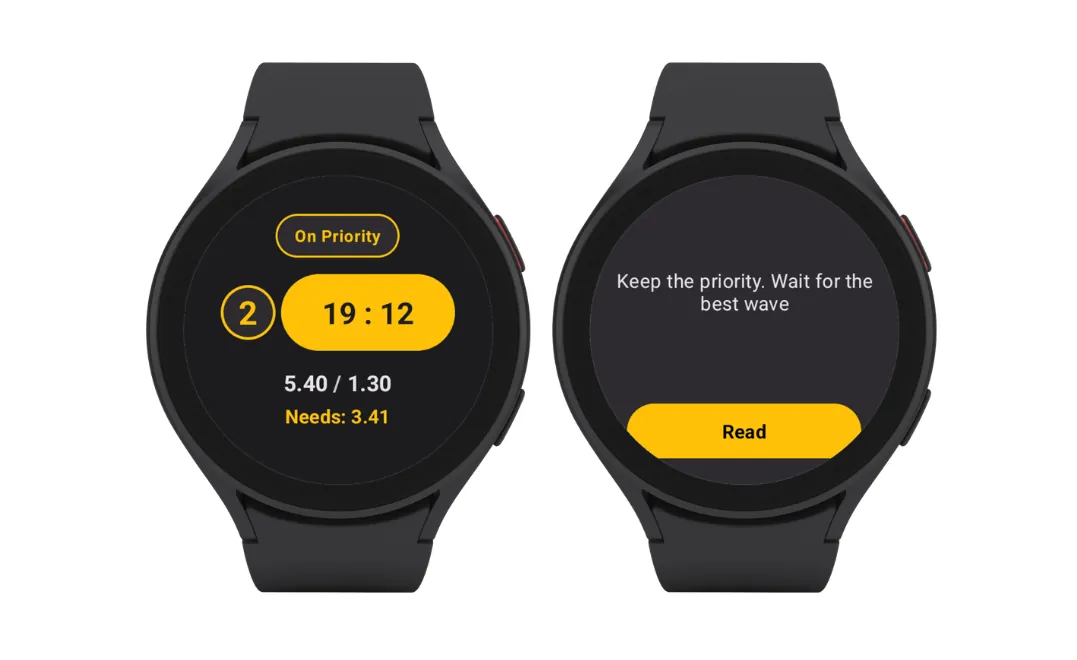 The Surf Watch App for Real-Time Coaching