Surf Training Drills for Competition
The gap between a good free surfer and a good competitor is rarely technique — it's that events add a clock, a scoreboard and a queue, and most surfers only face those three things a few times a year. These drills close that gap by making competition mechanics a weekly training habit. Each one assumes you understand how heat scoring and priority work.
1. The full simulated heat
The foundation drill. Two to four surfers, a 20–25 minute clock, live scoring from the beach, priority in effect. Everything else on this page is a variation of it.
- Setup: set a heat with real names, a countdown and a starting priority order. Score every ridden wave 0–10 against the standard criteria.
- Goal: best two-wave total wins. Post results — surfers should feel the outcome.
- Coaching note: resist pausing to give feedback mid-heat. The debrief afterwards, over the wave-by-wave scores, is where the learning happens.
2. Needs-chasing
Start a surfer "behind" on a fictional scoreboard: they hold a 5.0 and a 4.0, the leader has 13.0, ten minutes on the clock. They must find the score they need before time runs out.
- Goal: train wave selection under a target — chasing a 8.0+ requires hunting a genuinely better wave, not surfing the same ones harder.
- Variation: flip it — give them the lead and make them protect it with smart priority use and low-risk waves.
3. Priority battles
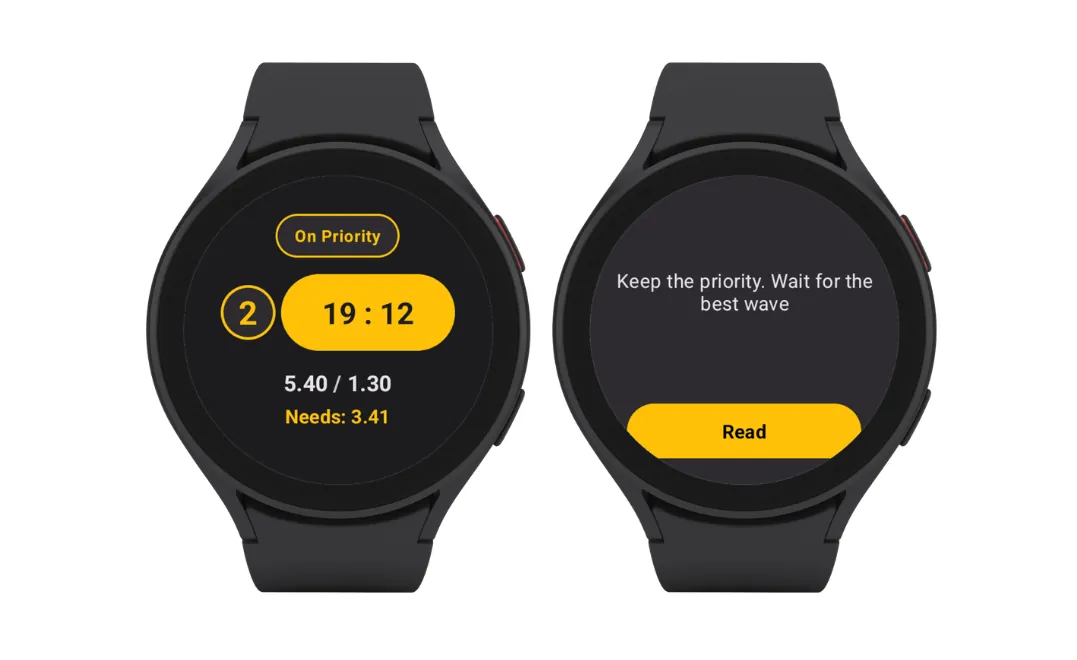
A two-surfer heat where the score is secondary and the queue is the drill: every wave caught rotates priority, and the coach narrates the queue state out loud (or the surfers read it live from their watches).
- Goal: make rotation awareness automatic — knowing your position without being told, and refusing to spend P1 on waves that can't score.
- Coaching note: afterwards, review which waves were caught at which priority position. A pattern of good scores caught at P3/P4 and junk caught at P1 is the most common leak in junior heats.
4. The two-slot game
A scored session with one constraint: each surfer may ride a maximum of six waves in 30 minutes. With a hard wave budget, every takeoff is a selection decision — exactly the economics of a real heat, where only the best two rides count.
- Goal: kill the habit of catching everything. Six attempts, two count — surfers learn to let mediocre waves pass.
5. Pressure finishes
Run only the last five minutes of a heat, repeatedly. Set a live scenario each round: trailing by 1.5 with priority, trailing by 3 without it, defending a narrow lead.
- Goal: repetitions of the exact minutes that decide events. A surfer might get five "final five minutes" in a whole season of competition — this drill gives them five in one session.
6. Scoreboard review
Not a water drill, but where the gains consolidate: after every scored session, walk through the timeline with the athlete. When were the counting waves caught? What was ridden that never had a chance of scoring? How did the last five minutes go against the needs figure? Over weeks, the statistics — averages, best waves, heat outcomes — show whether competition behaviour is actually improving.
All six drills need the same infrastructure: a clock, live scores, a priority queue and a record to review. Prosurfingtools runs exactly that from a phone or laptop on the beach — and puts the live score, position and needs on each surfer's smartwatch in the water, so the coach coaches instead of shouting numbers.
Frequently asked questions
How often should competitive surfers train heats?
Most competitive programs run at least one simulated-heat session per week in season, alongside free surfing and technique work. The goal is that event-day pressure — clock, scores, priority — feels routine rather than rare.
How many surfers do you need for a heat drill?
Two to four surfers per heat mirrors real formats, but with Prosurfingtools you can also add bots — placeholder surfers, not real people — to fill out the heat, so a single surfer can compete against a realistic scoreboard while the coach scores the bots' imaginary waves.
What should a coach review after a simulated heat?
Wave selection (did ridden waves improve the two-wave total?), priority usage (were good waves caught with or against the queue?), the scoreline timeline (when were the counting waves caught?) and how the surfer responded to the needs situation in the final minutes.
Related guides
 How Are Surf Heats Scored?
 Priority Rules in Surfing, Explained
 The Surf Watch App for Real-Time Coaching