Priority Rules in Surfing, Explained
Priority is competitive surfing's queueing system: at any moment, one surfer holds the exclusive right to the next wave. It sounds simple, but priority decides more close heats than turns do — because the surfer who manages the queue controls which waves everyone else is allowed to ride.
The basic rule
The surfer with priority (P1) has unconditional right of way. They can take any wave that comes through, sit as deep as they like, and no other competitor may catch that wave or paddle in their line. The instant P1 rides a wave, they surrender priority and drop to the back of the queue; everyone else moves up one position.
In most rule sets, paddling for a wave and missing it also costs you priority — you committed, so the queue rotates. That detail matters enormously for strategy: a fake paddle from your opponent is an invitation to waste your priority.
Priority in heats of three or four surfers
With more than two surfers, priority becomes a ranked order: P1, P2, P3, P4. Each position has right of way over everyone below it. When P1 rides a wave, P2 becomes P1, P3 becomes P2, and the rider rejoins at the back. In practice this creates a rotating queue — every wave you catch is also a small tactical payment, because it hands control to the surfers behind you.
Coaching note: multi-surfer priority is where juniors lose heats. A surfer who burns P1 on a mid wave early often spends the rest of the heat watching better waves go to opponents. Rotation awareness has to be trained, not explained.
Interference: the penalty that ends heats
If a surfer without priority catches a wave and hinders the priority holder — dropping in, taking off in front of them, or obstructing their paddle — judges call interference. The standard penalty is brutal: the offender loses their second counting wave, so their heat total is reduced to their single best score. In a format where two waves count, that is almost always the heat.
Note the wording: catching a wave without priority is not illegal by itself. If P1 lets a wave go, anyone below them in the queue can ride it freely (in order of their own priority). Interference only exists where the priority holder was actually hindered.
Training priority like it matters
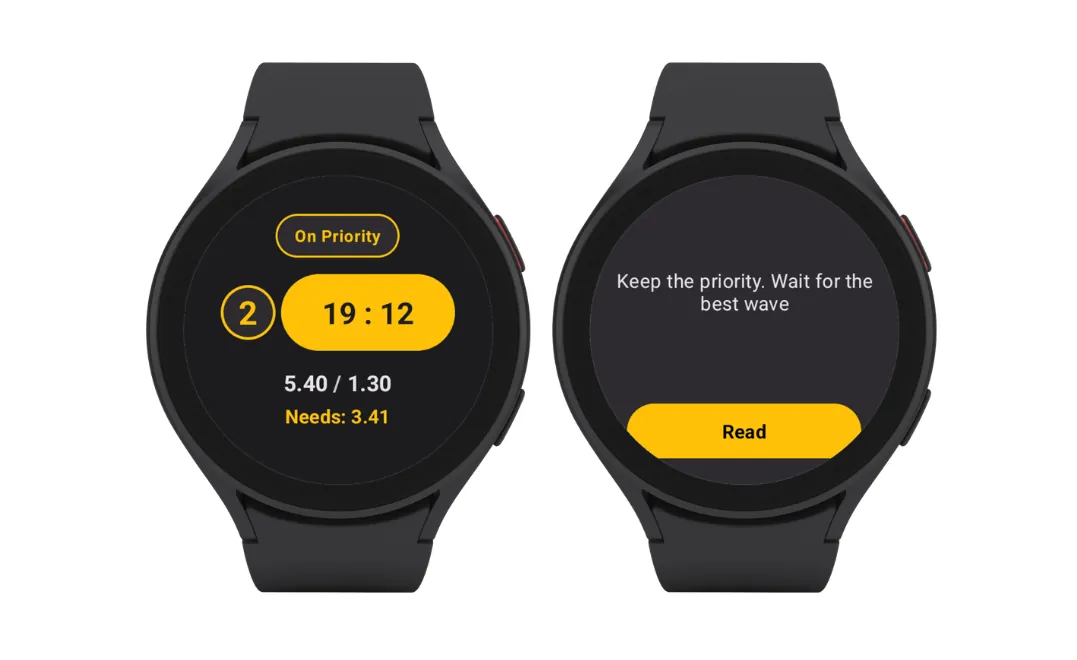
Most surfers only ever experience real priority pressure a handful of times a year, in events — which is exactly why it decides heats. In Prosurfingtools, coaches set the initial priority order for a training heat with a drag-and-drop queue, and the rotation then updates automatically every time a surfer catches a wave. Each surfer sees their live position — P1, P2, P3 — on their watch in the lineup, and every scored wave records the priority position it was caught with, so you can review afterwards whether good waves were won with the queue or wasted against it.
Frequently asked questions
What is priority in surfing?
Priority is the exclusive right of way for the next wave. The surfer holding priority can catch any wave they choose, and no other surfer may take off on it or hinder them. Priority rotates: once you ride a wave, you drop to the back of the queue.
How does a surfer lose priority?
You lose priority the moment you catch a wave, and in most rule sets also when you paddle for a wave and miss it. Priority then passes to the next surfer in the order.
What is an interference penalty?
Interference is called when a surfer without priority catches a wave and hinders the surfer who holds it, or obstructs their paddling. The standard penalty is losing your second counting wave — your heat total becomes just your best wave — which is usually fatal to the heat.
Who has priority at the start of a heat?
Nobody. At the start the wave goes to whoever is in position under the normal right-of-way rule (closest to the peak / first to their feet). Priority order is established after the opening exchanges — commonly, the first surfer to ride a wave goes to the back of the queue.
Does priority exist in heats with three or four surfers?
Yes. In multi-surfer heats priority is a ranked queue — P1, P2, P3, P4. P1 has right of way over everyone, P2 over everyone except P1, and so on. Riding a wave sends you to the back and moves everyone else up one place.
Related guides
 How Are Surf Heats Scored?
 Surf Training Drills for Competition
 The Surf Watch App for Real-Time Coaching