How Tides Work
Twice a day the sea climbs the beach and falls back again. For surfers this matters as much as the swell: the same sandbank can be perfect at low tide and flat at high tide. The cause is the gravity of the Moon and the Sun acting on a spinning Earth. Press play on the model below and watch it happen.
The Moon stretches the oceans
The Moon's gravity pulls on the whole Earth, but not equally. The side of the Earth facing the Moon is about 6,400 km closer to it than the centre, so it is pulled a little harder. The far side is further away, so it is pulled a little less. Seen from the centre of the Earth, the water on the near side is pulled towards the Moon and the water on the far side is left behind.
The result is two bulges of water, one facing the Moon and one on the opposite side, with lower water in between. In the model, the blue shell is that water, stretched along the line to the Moon. In reality the bulges are under a metre high in the open ocean; the model exaggerates them thousands of times so you can see them.
Why we get two tides a day
The bulges stay lined up with the Moon while the Earth turns underneath them. Follow the gold pin, your beach: as the Earth spins, the pin passes through a bulge (high tide), then the low water between bulges (low tide), then the other bulge (the second high tide), then low water again. Two highs and two lows for every turn.
But it isn't exactly 24 hours. While the Earth turns once, the Moon moves about 12° further along its orbit, in the same direction. The Earth needs about 50 more minutes to catch up and bring your beach back under the Moon. So a full tidal day lasts about 24 hours 50 minutes, the two high tides are about 12 hours 25 minutes apart, and the tide times move about 50 minutes later every day. Count the peaks in the graph under the model: two per day, slowly drifting against the clock.
The Sun: spring and neap tides
The Sun makes its own pair of bulges in exactly the same way. It is about 27 million times more massive than the Moon, but about 390 times further away, and the tidal effect falls with the cube of the distance. So the Sun's tide is only about 46% of the Moon's. It doesn't make separate tides that you notice; it makes the Moon's tides bigger or smaller.
- Spring tides: at new moon and full moon, the Sun, the Earth and the Moon are in line. The two pairs of bulges point the same way and add up: higher high tides, lower low tides, a big tidal range. Press either Spring tide button in the model.
- Neap tides: at the first and last quarter moon, the Sun and the Moon pull at right angles. The Sun's bulges fill in the Moon's lows, and the tidal range is small. Press Neap tide and compare the graph.
The two spring-tide line-ups have names. At new moon the Moon sits between the Earth and the Sun, which astronomers call conjunction. At full moon the Moon is on the far side of the Earth, opposite the Sun: opposition. Either way the three bodies are in a straight line, a syzygy. Both give spring tides of about the same size, because each body raises one bulge on the side facing it and another on the far side: with the Sun behind the Earth, its bulges still point along the same line as the Moon's. Compare the two spring-tide buttons in the model.
The full cycle from spring to neap and back takes about 14.8 days, half a lunar month. The word "spring" has nothing to do with the season; it comes from the water "springing" up.
Extra-big spring tides, sometimes called king tides, happen when a new or full moon falls near the Moon's closest point to the Earth (perigee), and around the equinoxes in March and September.
Why real tides are more complicated
The model shows the equilibrium tide: the shape the oceans would take if the Earth were covered by one deep ocean. The real Earth has continents in the way, ocean basins of different shapes and depths, and a Moon whose orbit is tilted. So:
- High tide rarely happens exactly when the Moon is overhead; each coast has its own delay.
- Some coasts get two unequal high tides a day, and a few get only one.
- Tidal range goes from a few centimetres in the Mediterranean to over 15 metres in the Bay of Fundy, Canada, where the shape of the bay amplifies the tide.
That is why you should always use the official tide table for your area. The Moon and the Sun explain the rhythm; the local coast decides the details.
What tides mean for your surf
In a typical two-tides-a-day pattern the water does not move at a steady speed. A useful rule of thumb is the rule of twelfths: in the six hours from low to high, the water rises 1/12, 2/12, 3/12, 3/12, 2/12 and 1/12 of the range in each hour. The tide changes slowest around high and low, and fastest at mid tide, which is when your spot changes fastest too.
- Learn the tide window of each spot: many beach breaks work best from low to mid tide on the push (rising), some reefs only at high.
- On spring tides the spot changes faster during a session, and tidal currents are stronger.
- On neap tides the conditions change slowly, which helps when you need a long, steady training session.
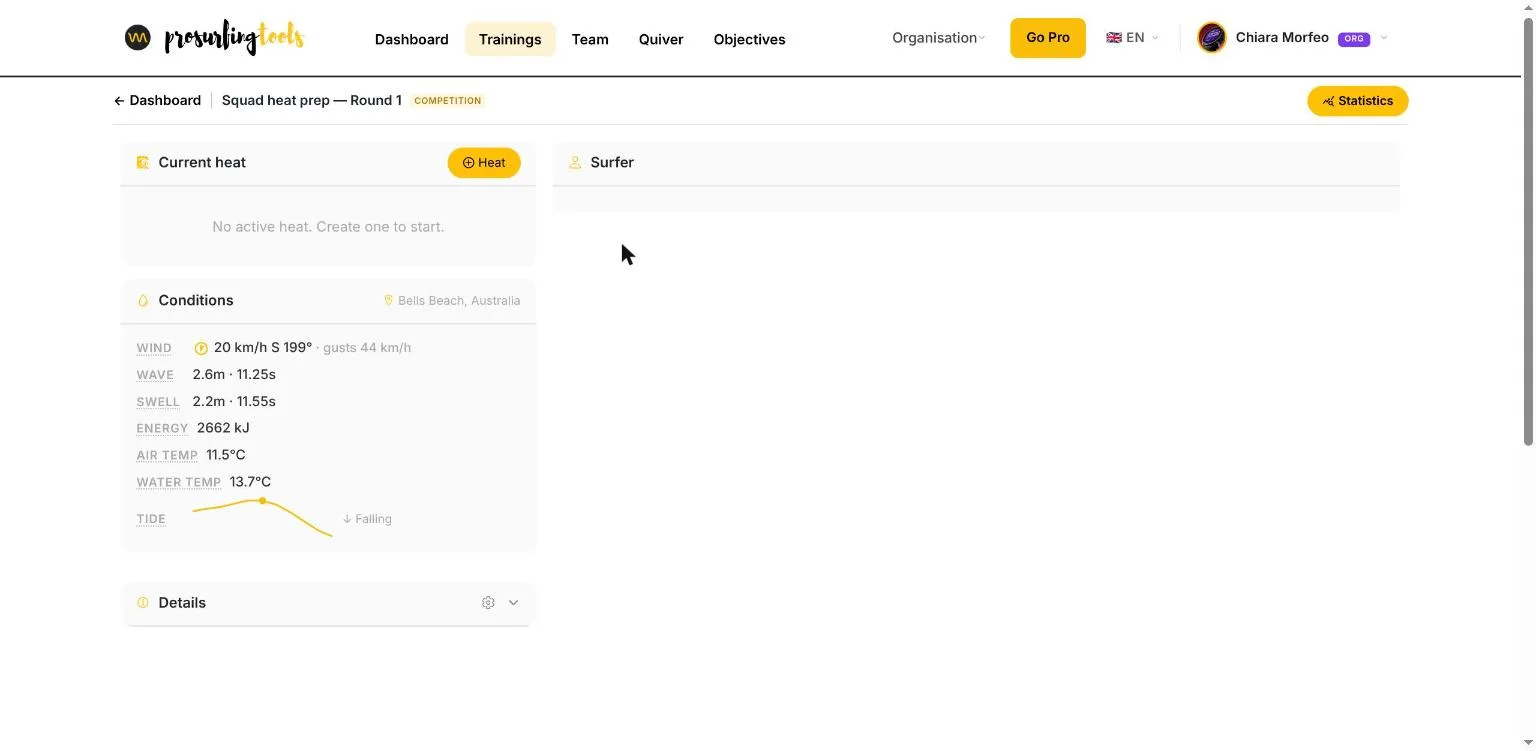
Read the tide together with the swell and the wind: the surf forecast guide shows how. In Prosurfingtools, a training with a location shows a tide curve for the hours around the session, rising or falling, next to the wind and swell.
Frequently asked questions
Why are there two high tides a day?
The Moon stretches the oceans into two bulges: one on the side facing the Moon, and one on the opposite side. As the Earth turns, each beach passes through both bulges, so it gets two high tides and two low tides.
Why are tides about 50 minutes later every day?
While the Earth turns, the Moon also moves along its orbit in the same direction. The Earth needs about 24 hours 50 minutes, not 24 hours, to bring a beach back under the Moon. So the two high tides repeat every 12 hours 25 minutes or so.
What are spring and neap tides?
Spring tides happen around new and full moon, when the Sun and the Moon are in line and their tides add up: the highs are higher and the lows lower. Neap tides happen around the quarter moons, when they pull at right angles and partly cancel each other out. They have nothing to do with the season.
Why does the Moon affect tides more than the Sun?
Tides are caused by the difference in pull between the near and far side of the Earth, and that difference falls with the cube of distance. The Sun is about 27 million times more massive than the Moon, but about 390 times further away, so its tidal effect is only about 46% of the Moon’s.
Does every coast have two tides a day?
Most coasts do, but not all. The continents, the shape of each ocean basin and the tilt of the Moon’s orbit change the pattern: some places have one tide a day, some have two unequal tides, and some seas like the Mediterranean have very small tides.
Related guides
 How to Read a Surf Forecast
 Swell Period Explained
 Offshore, Onshore and Cross-shore Wind
 Wave Energy in Surf Forecasts