Swell Period Explained
Two forecasts can show the same 1.5 m swell and produce completely different days. The difference is almost always the period: the number of seconds between one wave and the next. Period tells you how deep the energy goes, how fast it travels and how the wave will break when it reaches your spot.
What period measures
Stand on a pier and count the seconds between two wave crests passing the same post. That is the period. Forecasts usually give the peak period, the period of the swell that carries the most energy; some give an average period, which is lower when there is wind chop in the mix. Compare numbers from the same forecast source, not between different websites.
Period is set when the swell is born. The stronger the wind, the longer it blows and the larger the stretch of ocean it blows over (the fetch), the longer the period. A deep winter storm in the middle of the ocean makes 15–20 second swell; a day of local wind makes 5–7 second chop.
Groundswell and windswell
- Windswell (under about 8 s): made close to the coast. Waves are close together, weak and often messy, with little shape.
- Medium swell (about 9–11 s): a mix. Surfable and often fun on beach breaks, but without much power.
- Groundswell (about 12 s and longer): made by distant storms. Clean lines, organised sets, real power.
- Long-period groundswell (16 s and longer): heavy, with big sets, long lulls and strong surges and currents.
Why long period surfs bigger
A wave's motion reaches down into the water to about half its wavelength, and in deep water the wavelength grows with the square of the period. So a long-period swell reaches much deeper than a short one with the same height on the surface:
| Period | Wavelength | Feels the bottom at | Energy travels per day |
|---|---|---|---|
| 6 s | 56 m | ≈ 28 m deep | ≈ 400 km |
| 8 s | 100 m | ≈ 50 m deep | ≈ 540 km |
| 10 s | 156 m | ≈ 78 m deep | ≈ 670 km |
| 12 s | 225 m | ≈ 112 m deep | ≈ 810 km |
| 14 s | 306 m | ≈ 153 m deep | ≈ 940 km |
| 16 s | 400 m | ≈ 200 m deep | ≈ 1,080 km |
Deep-water values: wavelength ≈ 1.56 × period², group speed ≈ 0.78 × period (m/s).
Because a long-period swell feels the seabed so early, three things happen as it reaches the coast. It refracts (bends) more, so it wraps around headlands and focuses on reefs and sandbanks. It shoals more, growing taller as the water gets shallow, so it can break well above the open-ocean figure. And it carries more energy per metre of height, so the wave hits harder. A short-period swell does the opposite: it often breaks smaller than forecast and loses its shape quickly.
Sets, lulls and arrival times
Longer period also means longer gaps. In a 16-second swell the sets can be several minutes apart, with the lineup almost flat in between. Surfers who don't expect it paddle out in a lull, get caught inside by the next set or give up their position just before it arrives. Patience and positioning become part of the session.
In deep water, longer waves travel faster. That is why the first sign of a new swell is long-period "forerunners": a few slow, big-spaced sets with a high period. Over the next hours or days the period drops and the swell fills in. If the forecast shows the period rising sharply overnight, a new swell is arriving.
Coaching note: in a long-period swell a 20-minute heat may only give five or six sets. Wave selection and priority become much more important than in a busy short-period sea, where there is always another wave coming. Train both kinds of day.
Reading period together with the rest
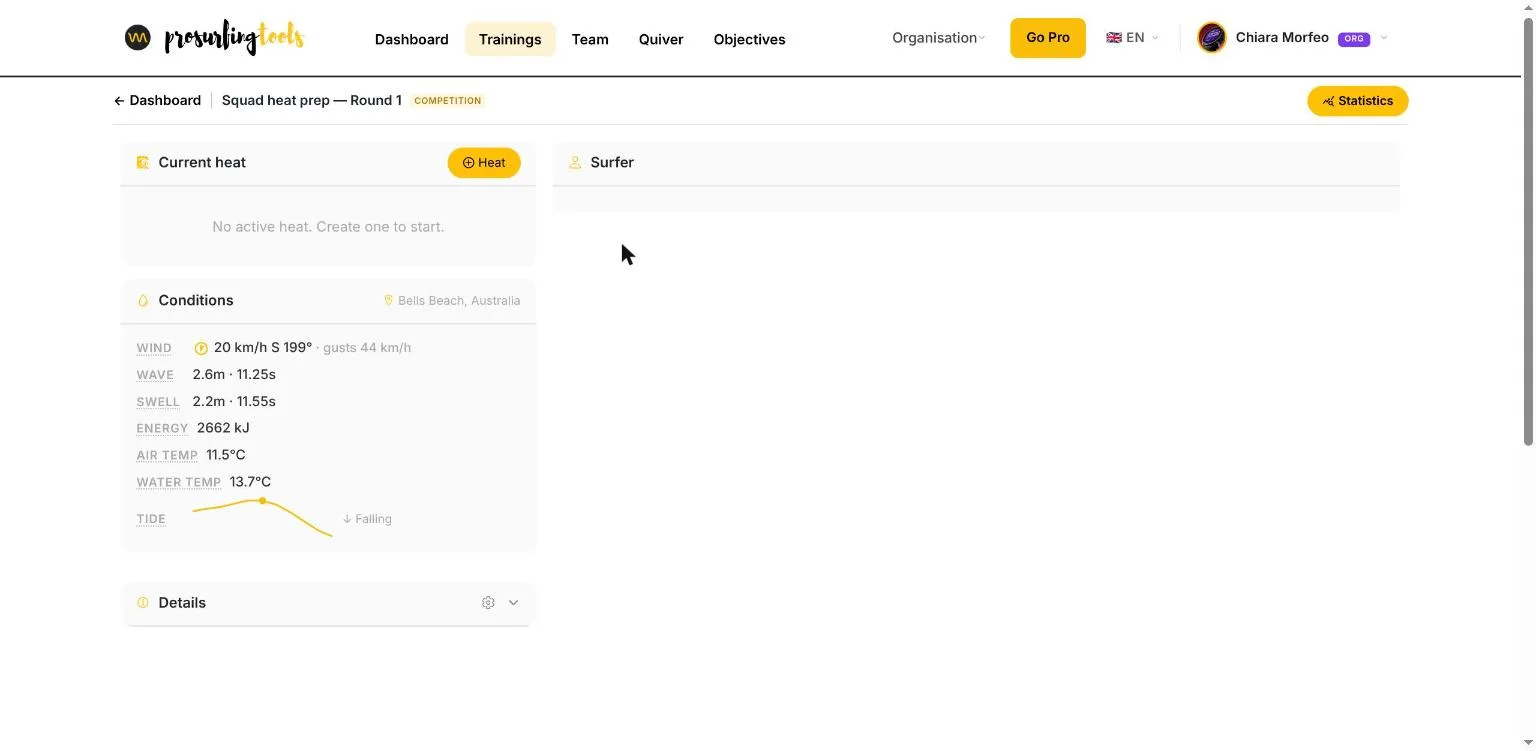
Period is not good or bad on its own. Read it with the height, the direction and the wind: a 13-second swell with onshore wind still gives choppy waves, and a 9-second swell with light offshore can be great fun on a sandbank. The surf forecast guide shows how to combine them, and in Prosurfingtools the conditions panel of each training shows the wave period and the swell period side by side.
Frequently asked questions
What is a good swell period for surfing?
For most beach breaks, anything from about 10 seconds up gives organised, surfable waves, and 12–16 seconds is the classic groundswell range. Below 8 seconds the waves are usually weak and messy. Very long periods (18 seconds and more) bring powerful waves with long lulls and strong currents.
Is a higher period always better?
Not always. Long-period swell has more power, which suits reefs and points but can make some beach breaks close out. It also brings longer waits between sets and stronger rips. For beginners and junior training, a moderate period is often safer and gives more waves.
What is the difference between groundswell and windswell?
Groundswell is made by a strong storm far away and arrives as clean, long-period sets, usually 12 seconds or more. Windswell is made by wind closer to the coast and has a short period, usually under 8–9 seconds, so the waves are smaller in power, closer together and less organised.
Why does the period drop during a swell?
In deep water, longer waves travel faster than shorter ones. The longest-period waves from a storm arrive first, then the period slowly drops over the following hours or days as the slower, shorter waves arrive.
Related guides
 How to Read a Surf Forecast
 Wave Energy in Surf Forecasts
 Offshore, Onshore and Cross-shore Wind
 How Tides Work