Offshore, Onshore and Cross-shore Wind
The swell decides whether there are waves. The wind decides what they look like. The same swell can be glassy and hollow at dawn and a choppy mess by lunchtime, only because the wind has changed direction. To read wind in a forecast you need two things: its direction relative to your beach, and its speed.
Read the direction the right way
Wind is named for where it blows from. A westerly, or a 270° wind, blows from the west towards the east. Arrows on forecast charts don't all follow the same rule, so check the legend of the site you use. To work out the offshore wind for a spot, face the sea: the offshore wind comes from behind you. A west-facing beach is offshore in an east wind, a south-facing beach in a north wind.
Offshore wind: holds the wave up
Offshore wind blows from the land out to sea, straight into the face of the incoming waves. It pushes against the top of the wave and holds it up, so the wave breaks a little later, in shallower water, and steeper. That is what makes hollow waves and barrels. It also smooths out the small ripples on the surface, which is why offshore days look so clean, with spray blowing back off the lip.
Too much of it is a problem. Above about 15 knots, a strong offshore wind holds the wave up so hard that it's difficult to paddle in, the spray blinds you at the take-off and you often get "hung up" at the top. It can also push a tired surfer, or a lost board, away from the beach. Beginners should be careful on strong offshore days.
Onshore wind: pushes the wave over
Onshore wind blows from the sea onto the beach, from behind the waves. It pushes the top of the wave forward so it spills over early, in deeper water, before the wave has become steep. The result is soft, crumbly waves that close out more often. Onshore wind also covers the surface with chop and makes its own short-period windswell on top of the groundswell, so the lineup becomes harder to read.
Light onshore wind (under about 8–10 knots) is often still surfable, especially on a good sandbank, and the softer waves can even suit beginners. Strong onshore wind usually leaves beach breaks blown out, with a strong current along the beach.
Cross-shore wind: somewhere in between
Cross-shore (or side-shore) wind blows along the beach. Its effect depends on the exact angle. Cross-offshore, blowing along the beach and slightly out to sea, is the regular "good" wind at many spots. Cross-onshore is closer to onshore and usually gives poor waves.
Cross-shore wind also changes the two sides of a peak. On one side the wind blows into the face of the wave and holds it up; on the other it blows from behind, so the rights can be clean while the lefts are messy, or the other way round. And it creates a sideways drift that pulls surfers down the beach: you need to paddle back to the peak all session long.
Wind speed in a surf forecast
| Speed | Offshore | Onshore |
|---|---|---|
| 0–5 kn | Glassy, the best | Glassy, still great |
| 5–12 kn | Clean, groomed faces | Some texture, surfable |
| 12–20 kn | Strong, hard to take off | Choppy, blown out |
| 20+ kn | Difficult and risky | Messy, strong currents |
Look at the gusts too: a 10-knot average with 25-knot gusts is very different from a steady 10 knots. 1 knot is about 1.85 km/h.
The daily wind cycle
On many coasts the wind follows a daily pattern. At night the land cools faster than the sea, so a light land breeze blows offshore at dawn. During the day the land heats up, the warm air rises and cool air from the sea moves in: the onshore sea breeze, strongest in the afternoon. That is why the early session is so often the best one, and why it is worth checking the hourly wind and not only the daily summary.
Coaching note: contests don't wait for offshore wind. Heats run in onshore chop too, and surfers who only train on perfect mornings struggle when they do. Plan some sessions in onshore wind on purpose and practise wave selection when every wave looks the same.
Wind together with swell
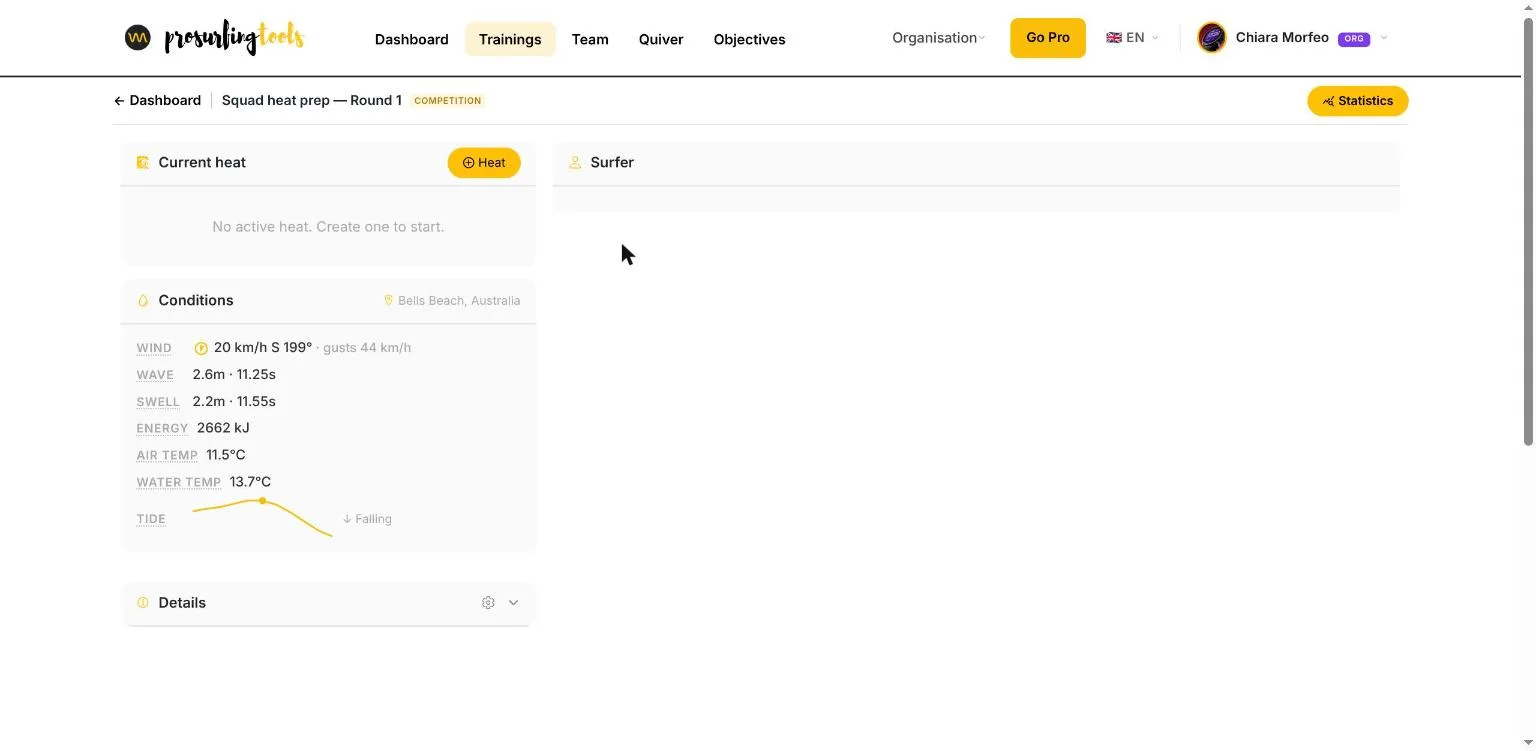
Wind matters more as the swell gets smaller and weaker: a powerful long-period swell (see Swell Period Explained) holds its shape in a bit of onshore wind, while a small short-period swell falls apart. To combine wind, swell, tide and energy in a single read, follow the surf forecast guide. In Prosurfingtools, the training conditions panel shows the wind speed in knots with its direction, and each finished heat keeps a snapshot, so you can see later what wind your surfers scored in.
Frequently asked questions
What does offshore wind mean in surfing?
Offshore wind blows from the land out to sea. It blows into the face of the incoming waves, holding them up so they break later, steeper and cleaner. Light offshore wind usually gives the best surf of the day.
Can you surf with onshore wind?
Yes, but the waves are softer, choppier and break less cleanly. Light onshore (under about 8–10 knots) is often still fun, especially on a good sandbank. Strong onshore wind usually leaves beach breaks blown out and messy.
Is cross-shore wind good for surfing?
It depends on the angle. Cross-offshore wind (blowing along the beach and slightly out to sea) can be very good. Cross-onshore is usually poor. Cross-shore wind also pushes surfers along the beach with a sideways drift.
How do I know which wind is offshore at my beach?
Stand on the beach looking out to sea and note the compass direction you are facing. The offshore wind comes from the opposite direction, from behind you. For a west-facing beach, an east wind is offshore; for a south-facing beach, a north wind is offshore.
How strong can offshore wind be before it is a problem?
Up to about 12–15 knots it usually helps. Above that, strong offshore wind makes it hard to paddle into waves, blows spray in your eyes at take-off, and can push a tired or inexperienced surfer away from the beach.
Related guides
 How to Read a Surf Forecast
 Swell Period Explained
 Wave Energy in Surf Forecasts
 How Tides Work